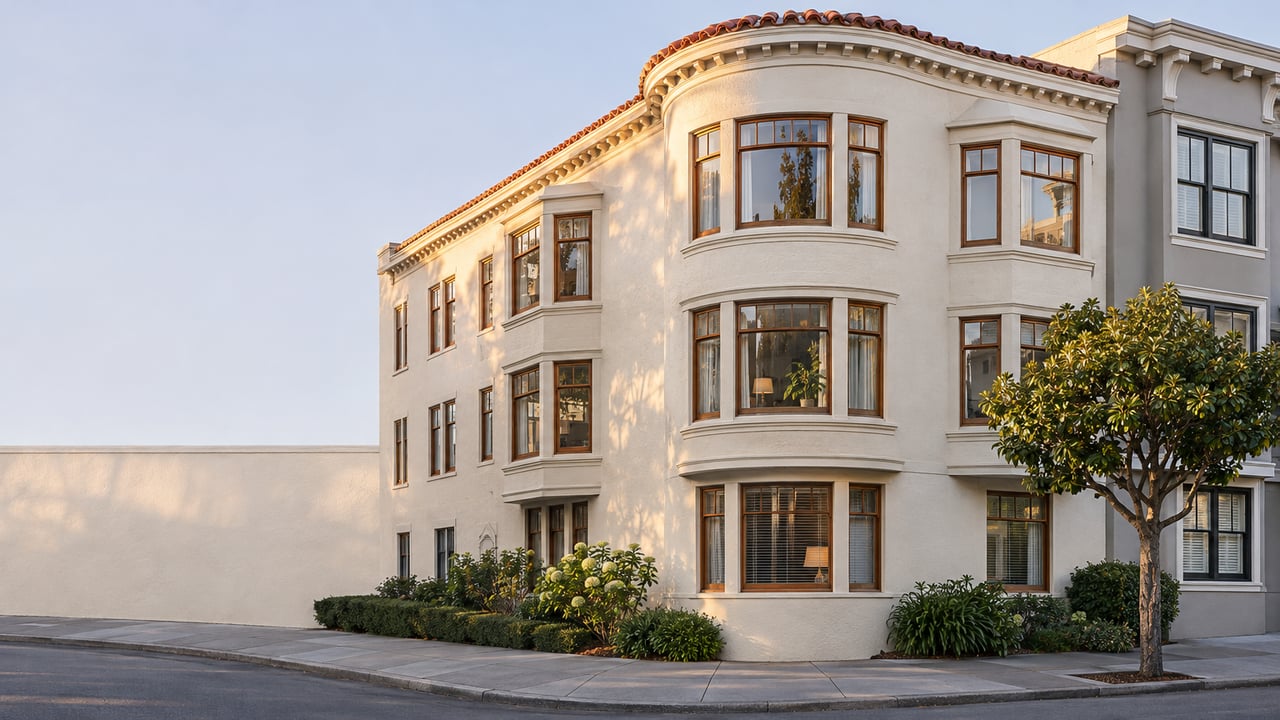
In late June, the listing agent for 3140 Pacific Avenue told her clients something simple, according to The Real Deal. If they wouldn't be happy at $7.5 million, they shouldn't list there. The sellers said that number would satisfy them. In less than a month the four-bedroom house beside the Presidio wall had half a dozen offers. It closed on July 22 at $12 million, 60 percent over the asking price.
The overbid also crossed a threshold in San Francisco's published transfer tax schedule. The schedule lists a 2.25 percent rate for sales from $5 million to under $10 million and a 5.5 percent rate for sales from $10 million to under $25 million.
For anyone selling in Pacific Heights this fall, that structure matters more than it used to. Bidding wars now decide the final price, and in this neighborhood they often finish near the $5 million and $10 million steps.
The rate is set by the whole price
Most people picture tax brackets as marginal: a higher rate applies only to the dollars above a line. San Francisco's documentary transfer tax doesn't work that way. The city's transfer tax page bases each rate on the "entire value or consideration" of the sale.
| Entire sale price | Rate per $500 | Effective rate |
|---|---|---|
| $1,000,000 to under $5,000,000 | $3.75 | 0.75% |
| $5,000,000 to under $10,000,000 | $11.25 | 2.25% |
| $10,000,000 to under $25,000,000 | $27.50 | 5.5% |
| $25,000,000 and up | $30.00 | 6% |
The San Francisco Standard reported on October 26 that the rate for $10 million to $25 million sales rose to 5.5 percent after voters passed Proposition I in 2020, and that the rate is among the highest in the country. It is more than double the 2.25 percent rate one tier down. Local custom has the seller pay this tax in an ordinary resale. New construction is a common exception, where buyers usually pay. The San Francisco Association of Realtors' general information advisory describes both, though the advisory was last revised in 2017.
Four Pacific Heights sales from 2026 against the schedule
The neighborhood's recent sales show how a bidding war can carry a house across a line, and how others close at or close to their asking price.
| Address | Asking price | Sale price | Tier at asking | Tier at sale |
|---|---|---|---|---|
| 2033 Baker St. | $3.99 million | $6.63 million | 0.75% | 2.25% |
| 3140 Pacific Ave. | $7.5 million | $12 million | 2.25% | 5.5% |
| 2023 Pacific Ave. | just under $8 million | $8.25 million | 2.25% | 2.25% |
| 2670 Pierce St. | $9.85 million | $9.85 million | 2.25% | 2.25% |
At 2033 Baker Street, a 2,600-square-foot, four-bedroom house a few blocks from the Presidio, the listing agent told The Real Deal that the $3.99 million price was "deliberately low." She expected a result in the high $4 millions, maybe $5 million. The house listed August 7 and drew 16 offers, the lowest of them $400,000 over asking. It sold August 12 for $6.63 million. That expected range sat right on the $5 million line.
The other two rows show a different pattern. The detached Victorian at 2023 Pacific Avenue, two blocks north of Lafayette Park, listed August 17 at just under $8 million. It was in contract a month later and sold for $8.25 million, according to the San Francisco Standard. The buyers' agent said a house occasionally gets overlooked, and sometimes it's "just dumb luck." The seven-bedroom, 7,090-square-foot house at 2670 Pierce Street listed in September and sold for its full $9.85 million asking price, the San Francisco Chronicle reported on October 16. That price sits $150,000 below the 5.5 percent tier.
These two sales fit the broader record better than the overbids do. The Real Deal, citing Compass data in July, reported that Pacific Heights homes had largely sold at asking in 2026, which made the 3140 Pacific result stand out. A Pacific Heights seller can end up with either outcome, and nobody can tell from the list price which one is coming.
Why the tier is so hard to predict
Sellers usually know roughly which tier they'll land in because comparable sales tell them. This fall, comps are a weak guide. The San Francisco Chronicle's October 26 market report quoted one agent saying recent comparable sales are almost something to "throw out the window." Another said that in this market, "aged data" means three months old.
When value is uncertain, sellers lean toward pricing low. According to the same Chronicle report:
- In September 2026, nearly 92 percent of San Francisco single-family homes sold above asking, the highest share on record.
- The average single-family sale in September 2026 closed nearly 30 percent over list, compared with 13 percent in September 2025.
- One agent described sellers pricing about a third below market value this year to set up "auction-style" sales. Another called pricing low and seeing what happens "the safe thing to do."
That strategy brings in buyers. It also means the final price gets set in the last round of offers instead of on listing day. A house priced a third below its likely value at $3.5 million could plausibly finish near $5 million. One priced at $7 million could finish near $10 million.
More Pacific Heights houses are also landing near those lines. The San Francisco Standard reported on October 25 that citywide sales above $5 million rose 109 percent year over year. A Compass agent quoted there said homes around $7 million had gone up 30 to 40 percent. City chief economist Ted Egan told the Standard that growth in upper-end residential sales can be "an important stabilizer" for a volatile transfer tax revenue stream.